Costanza Effect and the Andreessen Corollary
Marc Andreessen says fade the Harvard and Stanford MBAs. We checked 58,000 grads across 42 classes.
George Costanza found the secret to success was to stop trusting his instinct.
Marc Andreessen has identified a Costanza proxy: Harvard and Stanford MBAs. When HBS and GSB grads flood tech, be careful. When they retreat to banking, start looking at startups.
Let's go to the data. ~58,000 HBS and Stanford GSB grads across 42 classes.
Surprise, He's Right
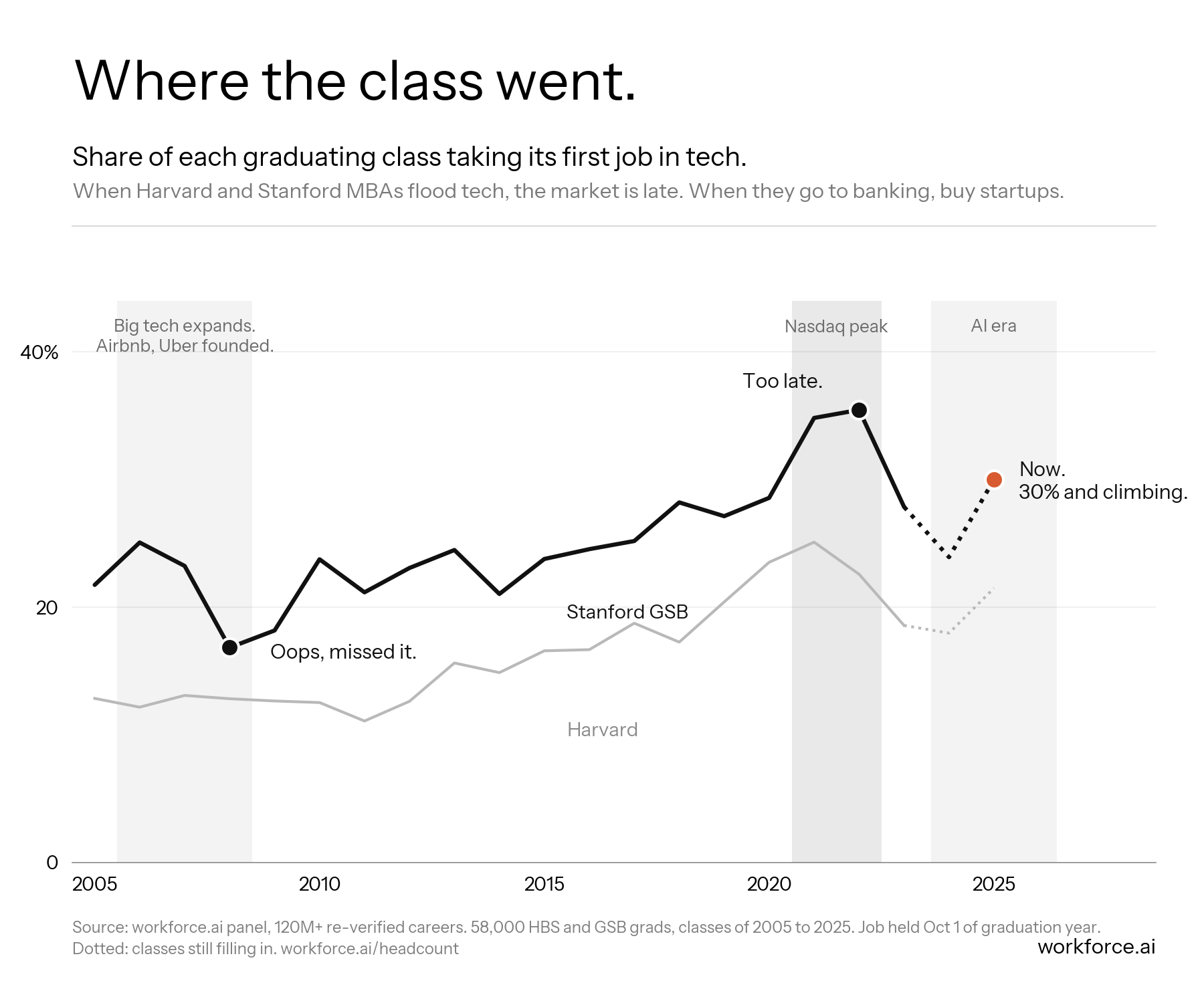
Stanford's tech share hit 36% with the class of 2022, the highest in our panel. Those offers were signed in the year before November 2021, just about the worst possible time to conclude tech only went up. Two years later it was 24%. Quick learners, that lot!
And the bottom? A correct Marc-to-market call. The classes of 2006 to 2008 bailed on tech. While Facebook, Twitter, Airbnb, Uber, and many other tech companies exploded, very few MBAs were in the room.
Because AI
But they're back now. Stanford sent 30% of its 2025 class into tech. By the schools' own count it's a record at both. Google hired as many Stanford MBAs this year as McKinsey and Bain combined. And risk is back: "Stealth Startup" is a top-five employer at both schools, and HBS says 17% of its class started a business, another record.
The odd part is banking never came back. Goldman, Morgan Stanley and JPMorgan took 22 Stanford MBAs from the class of 2011 and about 50 from HBS in 2006. For the current classes, that hiring has collapsed.
Consulting still dominates. MBB took 722 of the last 12,000 grads, more than every named tech company combined. But even there the MBA started fading early. McKinsey's HBS/GSB headcount peaked in 2021 and is down a third. Google's peaked in 2022 and is down 22% while the company is flat.
Dare we say the MBA is becoming a marginal hire? Added when growth is easy, cut when the ish hits the fan?
And now that marginal hire has moved.
In January 2023, 23 HBS and GSB grads worked at AI labs. Today our panel shows 300+. I guess even the fastest-growing companies in a once-in-a-lifetime industry need a little process.
Andreessen Corollary: Valid
Are HBS and GSB grads a counter-cyclical indicator as Marc implies? Pretty much.
If we want to be polite, the 2025 class doesn't look wrong as much as it looks late. GSB and HBS students often sign offers 12 to 18 months before their jobs start. So the class of 2022 is really telling you what looked attractive in early 2021. By the time they show up, the market may have moved.
We have two clean examples in the data: 2006–08 and 2021–22. In both cycles the best and brightest piled in near the top and backed away after the turn. And in both, some of the best companies of the next cycle were getting started while the MBA crowd luxuriated in the warm embrace of banking and consulting.
Andreessen's Corollary suggests the next great tech company is being built right now...but not by GSB/HBS alums.
They're at the big AI labs. Planning offsites or doing other MBA stuff.