ChatGPT-gate
A Saudi engineer, a Saudi prince, Ben Horowitz and a toilet paper roll. Alex Jones wanted the workforce data. Here it is.
Alex Jones slid into our inbox last night. Wanted workforce data on ChatGPT-gate. He gave us permission to share it with our readers too.
A Saudi national on OpenAI's payroll gets arrested by the FBI for allegedly bugging the executive boardroom. On the side, he's a venture partner at a Riyadh VC fund, where a Saudi prince is also a venture partner. The prince also founds Echelon, whose whole business is helping the Saudi government and the Kingdom's biggest companies better leverage AI. And oh yeah, they're getting into defense too, and Ben Horowitz writes a check.
The company launches October 8. The engineer gets arrested October 9. And Echelon's executive team? Almost everyone is from Microsoft, OpenAI's biggest backer.
We lay out the case below, but for those who don't like words and prefer pictures, here's one that clearly lays out the obvious, logical, totally undisputed facts of the case in a convincingly convincing manner.
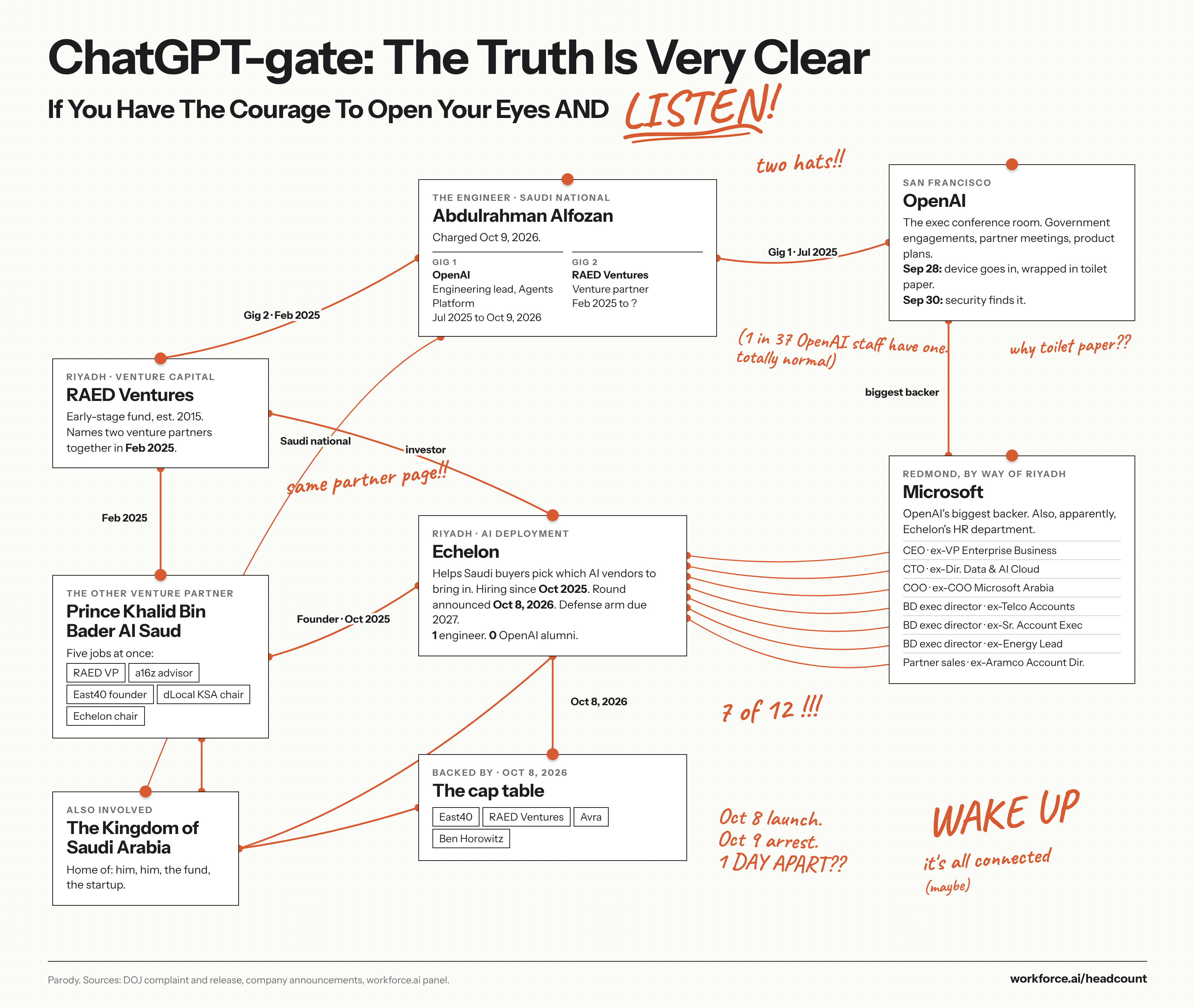
Ok. Alex didn't actually call. And that's not his chart. It's ours. But it's exactly the chart you could make if you were paranoid and wanted to weave a mystery out of all the available data, which btw is totally authentic (really!). Every name, date, job and string came from the workforce.ai panel or the public record.
That's the beautiful thing about data. It has no narrative. It just is. The narrative is whatever you bring to the corkboard. So let's drop the red string, temper our Alex Jones impulses, and let the data speak for itself.
What actually happened: The FBI says Abdulrahman Alfozan, an OpenAI engineer, hid a recording device behind the TV in an executive conference room. Wrapped in hopefully unused toilet paper. A ChatGPT account tied to his spouse allegedly asked how to build and hide the thing. Whether it also asked if toilet paper wipes away all traces of evidence, the complaint doesn't say.
Nobody knows yet who, if anyone, he was working for. So we did what we always do. We followed the people. When you follow the people you land somewhere on a spectrum between interesting and coincidence. Here's where each string on that corkboard lands.
Interesting: his side hustle. Alfozan had another job, out in the open. Venture partner at RAED Ventures, an early-stage fund in Riyadh. Listed on his LinkedIn profile, the firm's site and in investor databases. RAED named its venture partners in February 2025. He joined OpenAI that July.
Might sound shady, but it's more common than you might imagine.
About one in 37 people at OpenAI lists an active side gig with a checkbook or a board seat attached. Anthropic runs higher. Google DeepMind runs lowest, which tracks with Google lawyers being Google lawyers. Lab staff angel-investing and advising is the water everybody in the Bay swims in.
Interesting: The other venture partner. RAED named two venture partners together in February 2025. One was Alfozan. The other was Prince Khalid Bin Bader Al Saud, a member of the Saudi royal family, who that fall founded Echelon. Echelon's pitch: help the Saudi government and big Saudi companies leverage AI. It picks which global AI vendors the Kingdom's ministries and enterprises bring in, localizes the tech, and then does FDE-type work deploying it. Next up in early 2027, Echelon Defense Industries. The prince himself also has an interesting side hustle as an advisor to Andreessen Horowitz.
Sounds like an interesting company, so let's take a look at the people.
Still small numbers in our panel, but of the 12 we have info on, seven came straight from Microsoft. The CEO, Omar Saleh, was Microsoft's VP of Enterprise Business in the region. The CTO ran a data and AI cloud group. The COO was COO of Microsoft Arabia until July. Four of the business development hires sold Azure into Saudi telcos, utilities and Aramco.
Coincidence: The timing. This is the string Alex would pull hardest.
A launch announcement and an arrest a day apart. Odder still, the complaint says the bugged room was where OpenAI discussed government engagements, commercial relationships and partner meetings, so you can see why Alex thinks this is exactly the meeting a company in the business of picking a country's AI vendors would love to sit in on.
The verdict: Data is data. Boring so far. Nobody else is named in the complaint, though that could change. A sober look at the data says people at the labs do have side hustles, and of course Microsoft alums would be eager to resell OpenAI in a region where they have a lot of contacts. But put it on a corkboard, add a few notes of John le Carré spycraft, and you have the makings of a great story.
Until you find out the main conspirator allegedly asked ChatGPT how to spy on ChatGPT.
That's not how any of le Carré's conspirators were caught.
Ask the workforce
But don't trust us. Do your own investigation.
Any other spies at OpenAI? Kidding. Where do OpenAI's people come from, and where do they go when they leave?What about Anthropic? Where do Anthropic's people come from, and where do they go when they leave?See it live. OpenAI's genome, or OpenAI against Anthropic, on workforce.ai.