Nothing is random.
Your genes don't decide your fate but they tilt your odds. Same goes for the economy.
Nothing is random. The company going sideways today was probably losing its best people a year before the filing. The one that just crushed the quarter hired top people from A-list companies a couple years prior. People move first…then the money follows.
And now we're going to measure it, one career at a time. Every worker has a history. When you roll up a few thousand you start to see something that is a decent proxy for a company's DNA. Traits like ancestry, how long people last, how far they get, and whether the next generation does better than the last.
The crazy big goal is to build a 23andMe for the economy. We're starting with companies, sectors, cities, and colleges. We want to catalog the traits, follow where people go, and see what happens to the organizations they join and leave. Eventually we'll have enough history and clear understanding of the dynamics to suggest what's likely to come next. In the interim, we think there are still plenty of interesting insights one can learn from looking at various workforce "genomes."
Let's start first with the real easy problem, the nature/nurture debate…
Guess which one of these defense companies makes drones?
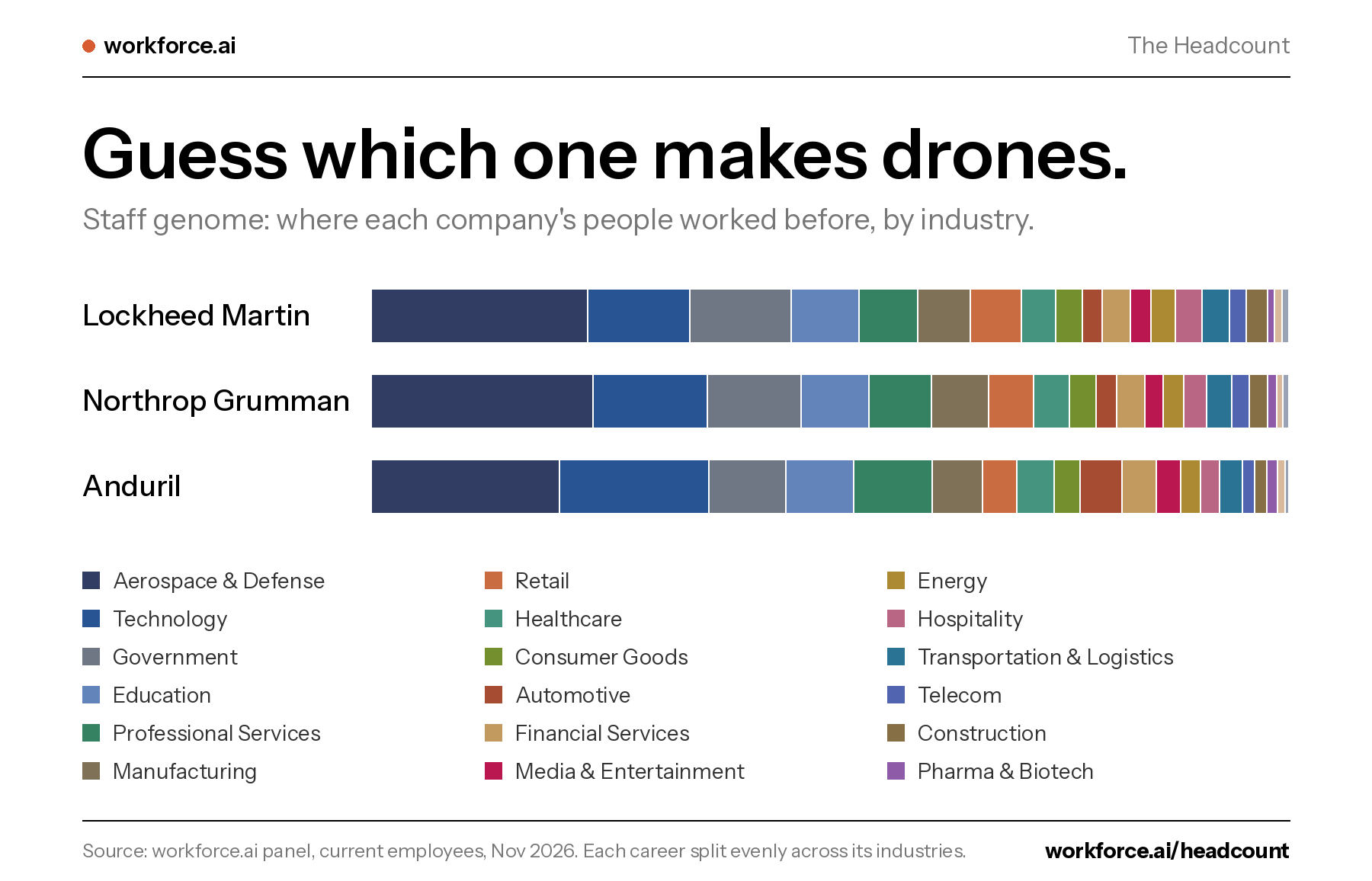
Look at their company DNA and they look like triplets; look at their portfolio of defense platforms and they couldn't be more different. Anduril's single biggest source of hires is Northrop. So how do the same people end up building something so different? Nurture. When we dig in to the roles we see Anduril carries about half the program managers and finance and admin folks that the primes do, and common roles like "Mission software engineer" and "flight test engineer" that don't crack the top-25 titles at the Defense Primes. And juniors get promoted more quickly at Anduril too. See all the data for each here.
Let's move on from the nature/nurture to the equally simple genetic question of inheritance, where certain genes do their gene thing and beget more of themselves.
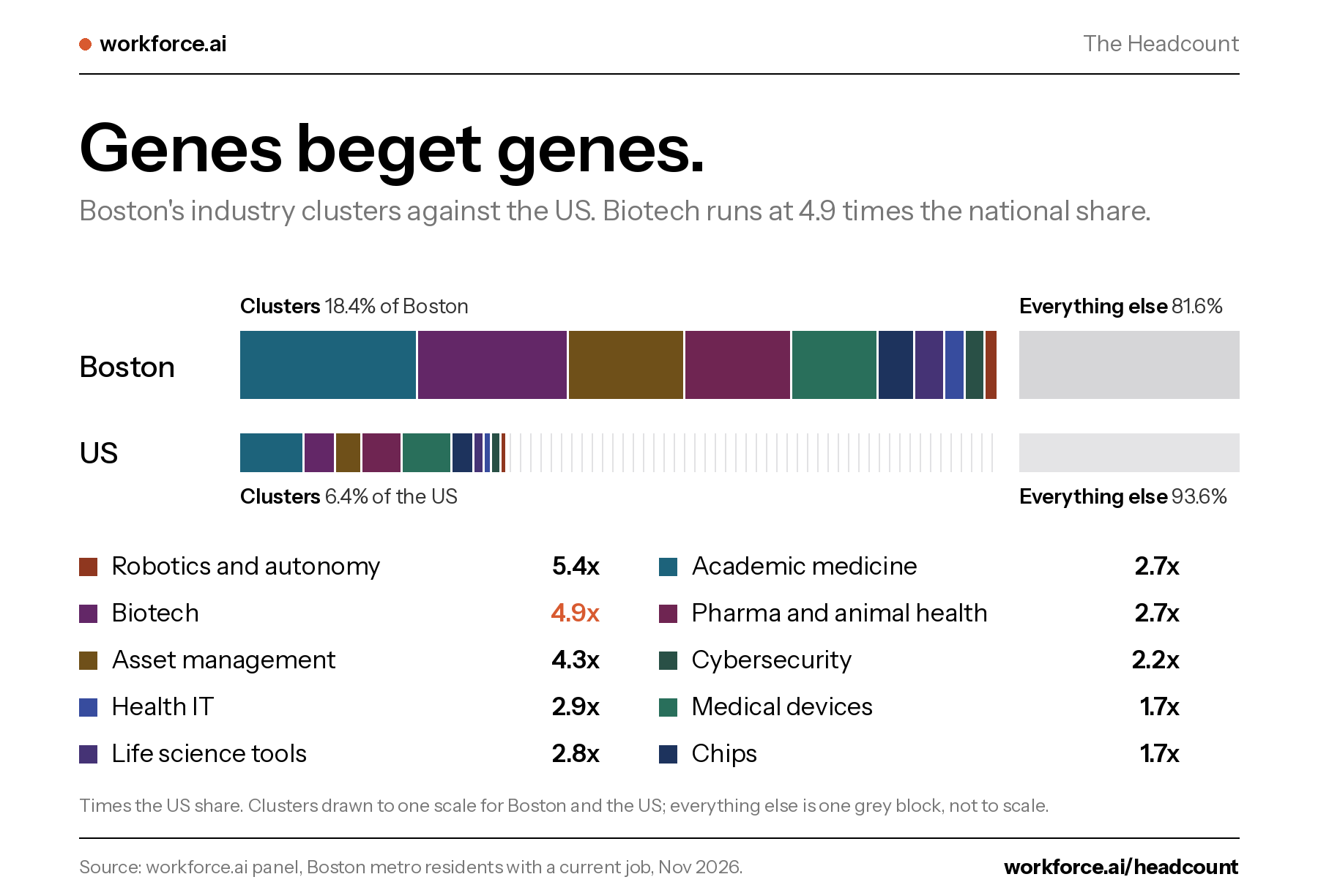
Sure Boston has a lot of drug and biotech companies. But why? Harvard, MIT and the hospitals trained the scientists. Biogen and Genzyme put them to work. Top scientists leave to build and staff the next gen, Vertex and Moderna. Then Takeda and Sanofi moved in to be close to the talent. Vertex's third-biggest source of hires? Moderna. Every new lab adds to the gene talent pool, which makes it easier to open the next one. That's why another biotech startup lands in Kendall Square and not Union Square.
Surprise! Anduril is having the same effect, but in Costa Mesa not Boston. Its alumni are turning up at Saronic, Shield AI, Mach, CHAOS, Castelion and Hadrian, a whole crop of defense startups bred out of one gene pool in under ten years.
Nothing is random, and we intend to prove it. One person at a time.
Ask the workforce your own question.
Every chart in this piece came straight out of the workforce.ai panel: 120 million careers, re-verified every two weeks. The beta is free. Leave your work email and you are in.
Already in? Sign in
Ask the workforce
Take the question further. Each one opens live in the chat with the panel behind it.
Where do Anduril's alumni go?Where does Moderna hire from?How fast do engineers get promoted at Lockheed Martin?